ByAlex ParkerUploaded on10/2/2026
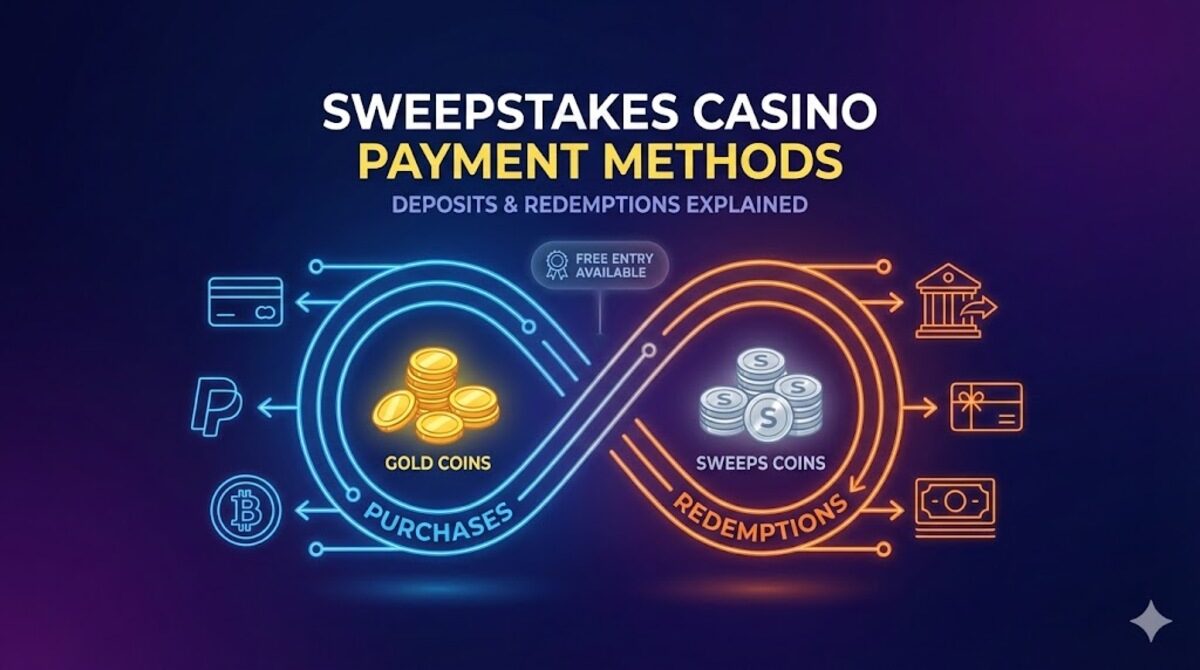
Sweepstakes casino payment methods in USA operate on two separate rails: purchasing Gold Coins for entertainment and redeeming Sweeps Coins for prizes or cash equivalents. Purchases commonly use Visa, Mastercard, Apple Pay, Google Pay, or limited e-wallets, while redemptions typically rely on ACH bank transfers, Skrill, PayPal (where offered), or gift cards through services like PrizeOut. These platforms function under promotional sweepstakes rules rather than traditional online gambling licenses in most states. Clear distinctions are outlined in analyses of the Unlawful Internet Gambling Enforcement Act (UIGEA) exclusions for free promotional credits.
Many players assume that depositing and withdrawing at a sweepstakes casino works the same way as a regular bank transfer or traditional online casino. This leads to declined cards, unexpected waiting periods, or confusion when a method works for buying coins but not for cashing out. The knowledge gap matters because it causes wasted time, extra verification steps, and unnecessary frustration.
This guide draws on publicly available explanations of the dual-currency model, Nacha Operating Rules for ACH transfers, UIGEA language regarding free promotional credits, and consistent patterns reported by independent banking resources. One practical illustration of mismatched expectations appears when players familiar with platforms like juwa in Usa encounter the more limited payment options typical of U.S. sweepstakes sites.
| Myth | Fact | Why It Matters |
| All major cards work for both purchases and redemptions | Cards (Visa, Mastercard, sometimes Amex/Discover) are mainly used for Gold Coin purchases; redemptions rarely go back to cards | Prevents failed cash-out attempts |
| PayPal is available at most sites | PayPal appears at only a minority of operators and is often one-directional | Avoids creating accounts that cannot be used |
| Crypto is widely available and instant | Crypto support is limited; network fees and confirmation times still apply | Sets realistic expectations |
| Bank transfers are always slow and expensive | ACH redemptions commonly take a few business days with little or no operator fee | Helps with cash-flow planning |
| You must buy coins before you can redeem anything | Free Sweeps Coins from sign-up, daily bonuses, or mail-in entries can be redeemed after meeting requirements | Encourages free play first |
| Gift cards are low-value or a last resort | PrizeOut-style gift cards often have lower minimums (sometimes 10 SC) and may include bonus value | Provides a faster, lower-threshold option |
| Apple Pay and Google Pay work for withdrawals | These mobile wallets are almost exclusively purchase tools | Saves setup time |
| Every site offers the same payment methods | Availability varies significantly by operator and state | Requires checking the cashier first |
| KYC is optional for larger redemptions | Identity verification is standard before first or larger prize claims | Prevents stalled requests |
| A declined purchase means the site is illegal | Banks and card networks apply their own risk filters even to legal promotional models | Separates processor policy from legality |
| “Instant” cash-outs are guaranteed | Instant usually applies only after internal approval and depends on the rail | Reduces disappointment |
| Physical cash can be deposited directly everywhere | Cash usually requires conversion via retail gift card + e-wallet (e.g., Skrill) | Clarifies the actual process |
Myth: Credit and debit cards can be used for both buying coins and receiving prize money.
Direct answer: Cards are among the most common ways to purchase Gold Coin packages but are rarely available for redemptions.
Explanation + evidence: Banking comparisons show Visa and Mastercard dominate the purchase side due to high mobile conversion, while redemptions shift to ACH, e-wallets, or gift cards because of network and processor policies.
Why the myth persists: Everyday banking teaches people that cards work both ways.
Concrete next step: Before making a large purchase, open the redemption section of the cashier and confirm the available outbound methods.
Myth: PayPal and Skrill are universally available and interchangeable.
Direct answer: Both appear at only a subset of operators, and support is often limited to one direction.
Explanation + evidence: Industry reviews consistently show Skrill more frequently available for dual use than PayPal.
Why the myth persists: Both are familiar e-wallets, so players assume equal support.
Concrete next step: Search the site’s banking or FAQ page for the exact wallet names.
Myth: Cryptocurrency offers anonymous, fee-free, and instant transactions.
Direct answer: Crypto is available at a minority of platforms; network fees and confirmation times apply, and KYC is still required for most redemptions.
Explanation + evidence: Where offered, Bitcoin and similar assets provide purchase and sometimes redemption options, but they remain secondary.
Why the myth persists: Broader crypto marketing emphasizes privacy and speed.
Concrete next step: Confirm whether the operator lists crypto on both the buy and redeem sides and account for network fees.
Myth: Bank transfers (ACH) are outdated and unreliable.
Direct answer: ACH remains one of the most common and reliable redemption methods and is governed by Nacha Operating Rules.
Explanation + evidence: Nacha establishes the framework for the ACH Network used by U.S. banks for electronic credits and debits.
Why the myth persists: Card and wallet marketing focuses on “instant.”
Concrete next step: Prefer a traditional bank account (Chase, Bank of America, or Wells Fargo) for larger redemptions.
Myth: Gift-card redemptions are a low-value or last-resort option.
Direct answer: Gift cards via PrizeOut or similar services often have the lowest minimums and can arrive faster than cash.
Explanation + evidence: Multiple guides note minimums as low as 10 SC at several operators, sometimes with added bonus value.
Why the myth persists: People associate gift cards with restricted spending power.
Concrete next step: Compare the cash minimum versus the gift-card minimum on the same platform before requesting a redemption.
Cards & Mobile Wallets Cluster
Myth: Apple Pay or Google Pay can be used to receive winnings.
Direct answer: These are almost exclusively purchase tools.
They tokenize an existing card for convenience on the buy side; outbound prize movement stays on bank or wallet rails.
E-Wallet & Instant-Feeling Cluster
Myth: Once a wallet is linked, every transaction is instant both ways.
Direct answer: Purchase speed is usually near-instant; redemption speed depends on the operator’s internal review plus the wallet’s processing time.
Players who bring firekirin in Usa based style instant expectations often encounter multi-day waits on first cash-outs.
Cash & Budget-Control Cluster
Myth: There is no practical way to use physical cash.
Direct answer: An indirect route exists by purchasing a retail gift card (CVS or Dollar General), loading it into an e-wallet such as Skrill, then buying coins.
This multi-step path is not available everywhere and can create a cash frenzy among new players who overlook the extra steps required.
Usa-Specific Context
Sweepstakes casinos operate under a patchwork of state laws and the federal UIGEA framework. There is no single nationwide regulatory body that issues licenses for these platforms the way some states license real-money online casinos. Availability of specific payment methods and state exclusions vary by operator. Players should always check the individual site’s restricted-states list and terms before registering or making purchases.
| Situation | Consideration |
| A purchase is declined more than once with the same card | Switch to another method (Apple Pay, Google Pay, or a different card) or contact the platform’s support to check for processor-side blocks. |
| A redemption has been pending longer than the stated processing window after KYC is complete | Open a support ticket with the request ID and screenshots. Most delays past the published window require manual review. |
| You need clarity on state-specific exclusions that remove certain payment methods | Check the operator’s restricted-states list or terms before attempting a large transaction. |
| Planning a large first-time redemption | Complete full KYC early and prefer a traditional bank (Chase, Bank of America, Wells Fargo) for smoother ACH routing. |
| Using a neobank with higher ACH rejection rates | Switch to a major traditional bank account for redemptions to reduce return risk. |
| Any request for payment outside the official cashier | Never send funds or details outside the platform’s verified redemption flow. Contact support immediately. |
| Situation / Number | What It Actually Tells You |
| Minimum redemption threshold (often 10 SC for gift cards, 50–100 SC for cash) | The earliest point at which your Sweeps Coin balance becomes usable for a prize claim. |
| Playthrough requirement on Sweeps Coins (commonly 1×) | How many times you must wager the promotional coins before they become redeemable. |
| Stated processing window (e.g., 1–5 business days) | The expected timeline after internal approval and KYC — not including verification time. |
| Daily or per-transaction maximum | The upper limit the operator will process in one request; larger amounts may need multiple claims. |
| Gift-card vs cash minimum difference | Whether a lower-threshold gift-card option can release value from a smaller balance faster. |
| “Instant” or “same-day” label | Usually applies only after the operator has already approved the request and depends on the specific payment rail. |
Sweepstakes casino payment methods in USA become straightforward once the dual-currency split is understood: cards and mobile wallets work best for buying Gold Coins, while ACH, select e-wallets, and gift cards handle most Sweeps Coin redemptions. Most friction comes from applying traditional banking or real-money casino expectations to a promotional model. Checking the cashier first, completing verification early, and matching the method to the direction of funds produces smoother results. Readers comparing operators may also find it useful to examine how different platforms present methods similar to those associated with vblink casino in Usa.
Common questions about this blog post.
Usually no. Cards are primarily for purchases.
No. It appears at a limited number of sites and is often restricted to one direction.
A few business days after internal approval and KYC, under Nacha network rules.
Often yes. Many operators set gift-card thresholds around 10 SC while cash starts higher.
Indirectly, by buying a retail gift card, loading it to an e-wallet such as Skrill, then purchasing coins.
No. Redemptions still require KYC at most operators.
Rarely. They are purchase tools.
No. Free Sweeps Coins can be redeemed once playthrough and minimums are met.
Confirm KYC is complete and contact the operator’s support with the request ID.